Phone Number
+91 9108788989
Email
contact@biostarlifetech.com

50 mm Sterilizing Filter

50 mm Sterilizing Filter

Membrane diameter: 50 mm
Membrane pore size: 0.22 μm
Pattern: Two stepped barbs, filling bell

Product Information

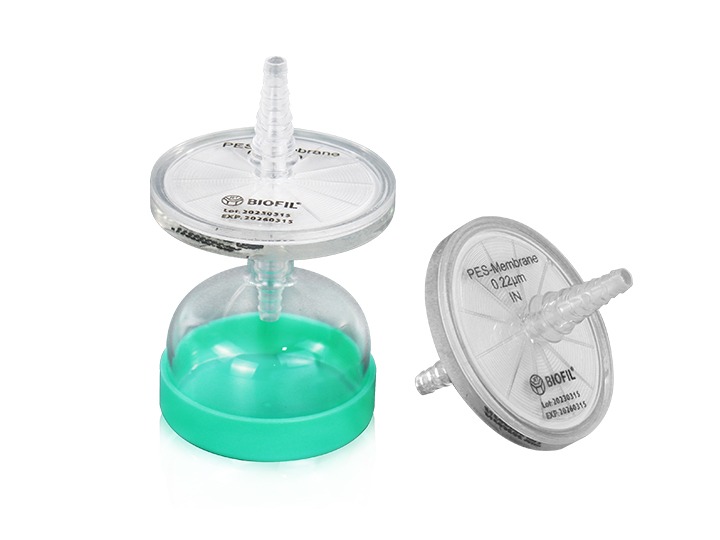
Positive pressure sterilizing filters are widely applicable to sterilizing filtration of aqueous solutions in biological laboratories, and can be used with a peristaltic pump, syringe or other positive pressure device. JET BIOFIL’s 50 mm sterilizing filter is suitable for removing microorganisms, particles, precipitates, and undissolved powders larger than 0.22 μm from aqueous solutions. This product has the stepped hose barb design that ensures stable connection between the filter and the hose.This product is made of 0.22 μm hydrophilic polyethersulfone (PES) membrane and can filter samples up to 8 L in volume. Its excellent filtration performance and reliable sterilization capability provide an efficient solution for the sterilizing filtration of liquids in biological laboratories

Filter surface with coding marks, clearly distinguish inlet and outlet

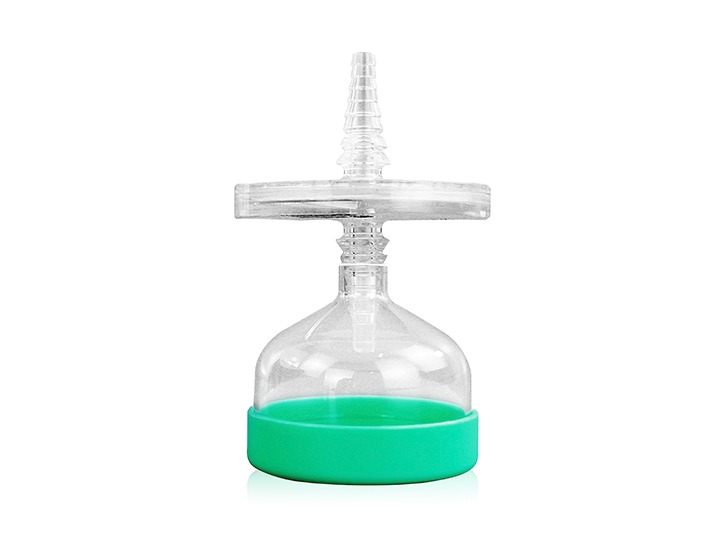
It is designed with a filling bell avoiding liquid splashing and pollution; Stepped hose barb design that ensures stable connection between the filter and the hose

50 mm Sterilizing Filter Features

Features
The filter membrane is made of 0.22 µm hydrophilic polyethersulfone for high throughput and excellent filtration performance
The products have an effective filtration area of up to 19.9 cm2, and can filter samples up to 3.8-8 L in volume
Maximum operating temperature: 45ºC
Maximum inlet pressure: 3.3 bars (50 psi) at 25ºC
Typical water flow rate: 390 mL/min at 25ºC under 15 psi
Features
It is designed with a filling bell avoiding liquid splashing and pollution
Stepped hose barb design that ensures stable connection between the filter and the hose
Filter surface with coding marks, clearly distinguish inlet and outlet
Sterilized by irradiation, SAL 10-6, DNase/RNase-free, non-pyrogenic, non-cytotoxic

Material

Filter housing

Methyl methacrylate-butadiene-styrene (MBS)

Filter Membrane

Hydrophilic polyethersulfone (PES)

Filling Bell

Polycarbonate (PC)

Filling Bell Cap

Low-density polyethylene (LDPE)

Conforming to USP Class VI Standards

Order Information

50 mm Sterilizing Filter

Cat. No. Description Compatible Tubing Range Membrane Pore Size (μm) Filter Diameter (mm) Outer Diameter (mm) Sterile Qty. Per Bag Qty. Per Case
FPE305050 PES membrane, two stepped barbs, filling bell 1/4"-3/8"ID 0.22 50 62 Y 1 10
FPE315050 PES membrane, two stepped barbs, without filling bell 1/4"-3/8"ID 0.22 50 62 Y 1 10

Frequently Asked Questions

What is the maximum rotational speed that the centrifuge tubes of Jet Biofil can withstand?
21000xg. Due to the different center distance of the rotor shaft of different centrifuges, the centrifugal force generated at the same speed (rpm) is also different, so we usually use the relative centrifugal force (RCF) (g) to represent the tolerance degree of the centrifuge tube in the process of rotating centrifugation.
Can the centrifuge tubes of Jet Biofil hold some kind of solution? How about its chemical compatibility?
It is necessary to pay attention to whether the sample is compatible with the material of the centrifuge tube as is used, especially if the sample is some chemical reagents or organic solvents, and the Chemical Compatibility Table of PP Plastic Materials can be used as reference. Samples with low or incompatible centrifugal compatibility are not recommended, and customers can also do pre-experiments to have a test.
What is the possible reason for the burst of the centrifuge tubes in the process of centrifuge?
When centrifuging, it is necessary to pay attention to the chosen centrifugal force cannot exceed the maximum centrifugal force that the product itself can withstand.

Please notice that the maximum centrifugal force (RCF) that can be withstood may be decreased when the sample is centrifuged at low temperature or the sample is an organic solvent/volatile irritant
What should be pay attention to when using the centrifuge tubes to preserve the samples at a low temperature?
When the sample is preserved below 0 ℃, the applicability of the centrifuge tube is closely related to the composition of the solution and preservation conditions. The centrifuge tube cannot be placed on the foam support, nor the bottom of the tube is in contact with the thermal insulation materials. And please use a hollow support when preserving the samples at low temperature. Otherwise, as part of the centrifuge tube is protected by thermal insulation material, while the other part is not, the temperature difference of the overall tube body makes the tube prone to burst. In addition, please reserve a space of at least 10% of the total volume to avoid sample spillage or tube burst caused by volume expansion due to liquid solidification.
Why the centrifuge tube smell special when its package is opened?
If you smell some odor in the product you receive, it is not because of the abnormal quality of the product. This is because some molecules will be vaporized and retained in the product/packaging in the process of high temperature injection molding/irradiation sterilization of the raw material plastic particles of centrifuge tube products.

The materials used for making the centrifuge tubes of Jet Biofil comply to the USP Class VI standards (USP Class VI Chapter, "Biological reactivity Tests, in Vitro" and Chapter, "Biological Reactivity Tests, in vivo”). No cytolysis or cytotoxic effects were observed through the verification. And the outgoing products in the process of quality inspection have passed various verification tests and are in line with the product release standards.
Call Now Button