Phone Number
+91 9108788989
Email
contact@biostarlifetech.com

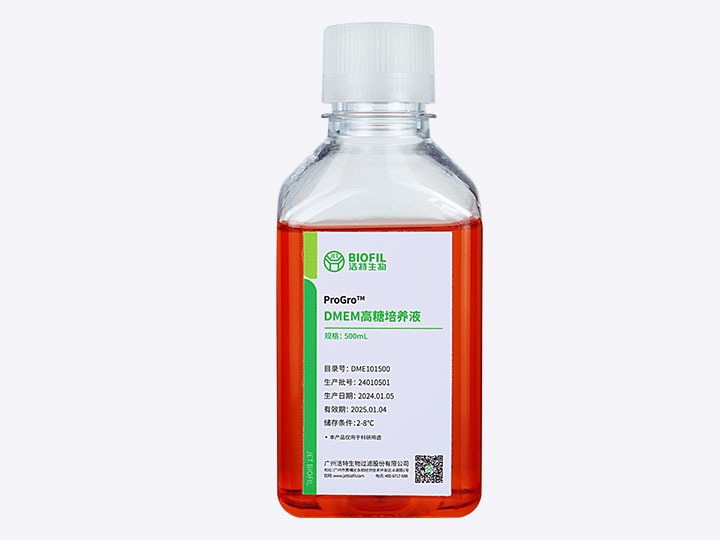
ProGro™ DMEM – high glucose

ProGro™ DMEM – high glucose

Specifications: 500 mL

Product Information

Jet Bio ProGro™ DMEM high-glucose medium is a widely used basal medium suitable for the culture of various mammalian cells, especially for high-density suspension cell culture. Its high glucose content (4.5 g/L) makes it widely applicable for fast-growing, low-adherence cells. It can be used for culturing myeloma cells, cloned cells, DNA-transfected cells, primary virus host cells, and single cells, as well as for vaccine production, such as using CHO cells to express EPO and produce hepatitis B vaccine.
 

ProGro™ DMEM – high glucose Features

Features
[+]4.5g/L Glucose
[+]3.7g/L NaHCO3
Features
[+]0.11g/L Sodium Pyruvate
[+]4mM L-Glutamine

Material

Polyethersulfone(PES)

Order Information

ProGro™ DMEM – high glucose

Cat. No. Product Name Specification Qty. Per Case Shelf Life Storage Condition
DME101500 ProGro™ DMEM High Glucose Medium 500 mL/Bottle 20 9 Months 2°C–8°C

Frequently Asked Questions

Size information of commonly used microwell plates?
The well plate size of this series conforms to ANSI/SBS well plate size standard, American National Standards Institute (ANSI ) and Society for Biomolecular Sciences (SBS, now affiliated to the Society for Laboratory Automation and Screening ( SLAS))
What is the chemical resistance of microwell plate?
In general, well plates are used for solution and cell culture. If organic solvents are involved, please confirm and verify the well plates according to the specific material of its before use.
What is the range of centrifugal force that the microwell plate can withstand?
We recommend that the centrifugal force not exceed 1,300 g. If there are other treatments affecting the mechanical strength of the well plate before centrifugation, the above suggestions may not be applicable. Please test and verify before use.
Does the deep well plate can be applied to cell culture?
It’s mainly used for sample treatment and preservation. The surface made of polypropylene has not been treated, and we have not tested it for cell culture. So it is recommended that you pre-test for specific applications and conditions before conducting relevant experiments.
Call Now Button