Phone Number
+91 9108788989
Email
contact@biostarlifetech.com

JetSpinĀ® Centrifugal Filters

JetSpinĀ® Centrifugal Filters

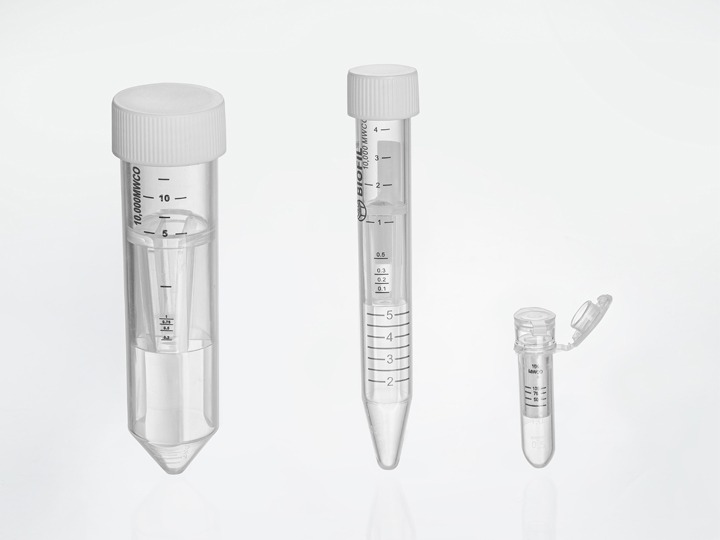
Inner Filter Specification: 0.5 mLĀ  5 mLĀ  15 mL
Tube Specification: 2 mLĀ  15 mLĀ  50 mL
Molecular weight cut off (MWCO): 3KDaĀ  5KDaĀ  10KDaĀ  30KDaĀ  50KDaĀ  100KDa

Product Information

The JetSpin® Centrifugal Filters have been newly upgraded! The filter membranes are made from premium polyethersulfone (PES), offering low protein adsorption, rapid filtration speed, and high recovery rates. Their single/double-sided vertical filter structure and support rib design provide a larger filtration area, reduced dead volume, and enhanced structural stability, allowing for higher centrifugal force compatibility while minimizing process losses.

Ā 

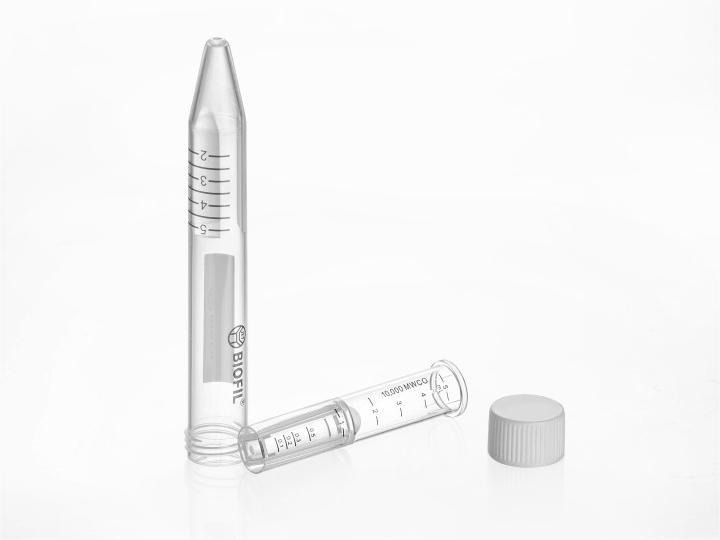
Molecular weight cutoff(MWCO) identification and volume graduation are etched on the side of the filter for easy identification and analysis

Built-in vertical polyethersulfone (PES) membrane filtration device efficiently recovers active components within the molecular weight range

JetSpinĀ® Centrifugal Filters Features

Features
Single (0.5 mL) /Double-sided (5 mL, 15 mL) vertical filter structure provides an effective filtration area of up to 9.7 cm²
Both 15 mL and 50 mL centrifuge tubes feature support ribs that are tightly integrated with membranes, facilitating enhanced structural stability and preventing membrane clogging or rupture under excessive centrifugal force
Rapidly concentrates samples in 5–25 minutes, achieving a concentration factor exceeding 100-fold
Features
Minimal void volume, reduces sample loss during centrifugation
Over 85% of protein recovery rate with excellent repeatability
Precise black graduations on the tube body with clear MWCO indicators, and writing area for easy marking
Membranes are secured into the filter shell using heat-pressing processes, without chemical leaching from adhesives that could contaminate samples and impact analysis results

Material

Centrifuge tube

Polystyrene (PS)

Tube cap

High-density polyethylene (HDPE)

Filter

Methacrylate-butadiene-styrene (MBS)

Filter membrane

Polyethersulfone (PES)

Conforming to USP Class VI Standards

Order Information

Cell and Tissue Culture Flasks , Non-treated

Cell and Tissue Culture Flasks, TC-treated

Cat. No.Volume(mL)Culture Surface Area(cm²)Type of CapRecommended Working Volume(mL)Maximum Working Volume(mL)Length(mm)Width(mm)Height(mm)Botte Neck Diameter(mm)SterileQty. Per BagQty. Per Case
TCF0110252512.5Plug Seal2.5-3.88.073.740.422.814.2Y10200
TCF0120252512.5Vent2.5-3.88.073.740.422.814.2Y10200
TCF0110505025.0Plug Seal5.0-7.517.592.949.529.118.2Y10200
TCF0120505025.0Vent5.0-7.517.592.949.529.118.2Y10200
TCF01125025075.0Plug Seal15.0-22.560.0152.581.535.225.0Y5100
TCF01225025075.0Vent15.0-22.560.0152.581.535.225.0Y5100
TCF011150375150.0 (U-shaped)Plug Seal30.0-45.0140.0199.7111.3111.325.6Y550
TCF022150375150.0 (U-shaped)Vent30.0-45.0140.0199.7111.3111.325.6Y550
TCF011175600175.0Plug Seal35.0-52.5250.0199.9122.749.225.7Y550
TCF012175600175.0Vent35.0-52.5250.0199.9122.749.225.7Y550
TCF011600600182.0Plug Seal36.4-54.6125.0219.3115.738.329.5Y540
TCF012600600182.0Vent36.4-54.6125.0219.3115.738.329.5Y540
TCF111600600182.0 (Extended)Plug Seal36.4-54.6200.0219.3115.749.529.5Y540
TCF112600600182.0 (Extended)Vent36.4-54.6200.0219.3115.749.529.5Y540
TCF011225850225.0Plug Seal60.0-90.0400.0221.9137.249.525.7Y525
TCF012225850225.0Vent60.0-90.0400.0221.9137.249.525.7Y525
TCF011850850300.0Plug Seal60.0-90.0200.0269.2166.047.029.5Y318
TCF012850850300.0Vent60.0-90.0200.0269.2166.047.029.5Y318

CellATTACHĀ® Cell and Tissue Culture Flasks

Cat. No.Volume(mL)Culture Surface Area(cm²)Type of CapMaximum Working Volume(mL)Length(mm)Width(mm)Height(mm)Botte Neck Diameter(mm)SterileQty. Per BagQty. Per Case
TCF0010252512.5Plug Seal8.073.740.422.814.2Y10200
TCF0020252512.5Vent8.073.740.422.814.2Y10200
TCF0010505025.0Plug Seal17.592.949.529.118.2Y10200
TCF0020505025.0Vent17.592.949.529.118.2Y10200
TCF00125025075.0Plug Seal60.0152.581.535.225.0Y5100
TCF00225025075.0Vent60.0152.581.535.225.0Y5100
TCF001150375150.0 (U-shaped)Plug Seal140.0199.7111.3111.325.6Y58
TCF002150375150.0 (U-shaped)Vent140.0199.7111.3111.325.6Y550
TCF001175600175.0Plug Seal250.0199.9122.749.225.7Y550
TCF002175600175.0Vent250.0199.9122.749.225.7Y550
TCF001600600182.0Plug Seal125.0219.3115.738.329.5Y540
TCF002600600182.0Vent125.0219.3115.738.329.5Y540
TCF101600600182.0 (Extended)Plug Seal200.0219.3115.749.529.5Y540
TCF102600600182.0 (Extended)Vent200.0219.3115.749.529.5Y540
TCF001225850225.0Plug Seal400.0221.9137.249.525.7Y525
TCF002225850225.0Vent400.0221.9137.249.525.7Y525
TCF001850850300.0Plug Seal200.0269.2166.047.029.5Y318
TCF002850850300.0Vent200.0269.2166.047.029.5Y318

Frequently Asked Questions

What is the maximum rotational speed that the centrifuge tubes of Jet Biofil can withstand?
21000xg. Due to the different center distance of the rotor shaft of different centrifuges, the centrifugal force generated at the same speed (rpm) is also different, so we usually use the relative centrifugal force (RCF) (g) to represent the tolerance degree of the centrifuge tube in the process of rotating centrifugation.
Can the centrifuge tubes of Jet Biofil hold some kind of solution? How about its chemical compatibility?
It is necessary to pay attention to whether the sample is compatible with the material of the centrifuge tube as is used, especially if the sample is some chemical reagents or organic solvents, and the Chemical Compatibility Table of PP Plastic Materials can be used as reference. Samples with low or incompatible centrifugal compatibility are not recommended, and customers can also do pre-experiments to have a test.
What is the possible reason for the burst of the centrifuge tubes in the process of centrifuge?
When centrifuging, it is necessary to pay attention to the chosen centrifugal force cannot exceed the maximum centrifugal force that the product itself can withstand.

Please notice that the maximum centrifugal force (RCF) that can be withstood may be decreased when the sample is centrifuged at low temperature or the sample is an organic solvent/volatile irritant
What should be pay attention to when using the centrifuge tubes to preserve the samples at a low temperature?
When the sample is preserved below 0 ā„ƒ, the applicability of the centrifuge tube is closely related to the composition of the solution and preservation conditions. The centrifuge tube cannot be placed on the foam support, nor the bottom of the tube is in contact with the thermal insulation materials. And please use a hollow support when preserving the samples at low temperature. Otherwise, as part of the centrifuge tube is protected by thermal insulation material, while the other part is not, the temperature difference of the overall tube body makes the tube prone to burst. In addition, please reserve a space of at least 10% of the total volume to avoid sample spillage or tube burst caused by volume expansion due to liquid solidification.
Why the centrifuge tube smell special when its package is opened?
If you smell some odor in the product you receive, it is not because of the abnormal quality of the product. This is because some molecules will be vaporized and retained in the product/packaging in the process of high temperature injection molding/irradiation sterilization of the raw material plastic particles of centrifuge tube products.

The materials used for making the centrifuge tubes of Jet Biofil comply to the USP Class VI standards (USP Class VI Chapter, "Biological reactivity Tests, in Vitro" and Chapter, "Biological Reactivity Tests, in vivoā€). No cytolysis or cytotoxic effects were observed through the verification. And the outgoing products in the process of quality inspection have passed various verification tests and are in line with the product release standards.
Call Now Button