Phone Number
+91 9108788989
Email
contact@biostarlifetech.com

PureFlow™ Capsule Sterilizing Filters

PureFlow™ Capsule Sterilizing Filters

Specification: D Series   L Series 2.0″   L Series 5.0″    L Series 10.0″

Product Information

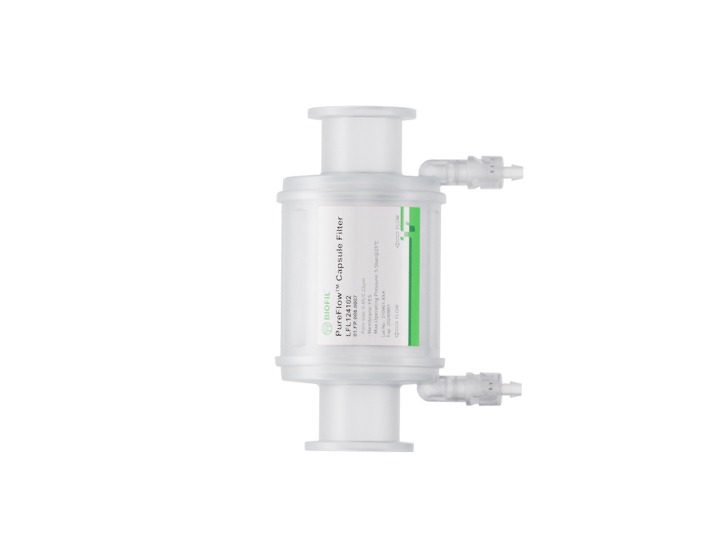
Capsule sterilizing filters are primarily used for the aseptic liquid filtration of cell culture media, buffer solutions, intermediate solutions, stock solutions, and semi-finished products in processes of biopharmaceuticals. They serve as critical consumables for aseptic liquid filtration and bioburden control in biopharmaceutical processes.

Jet Biofil’s PureFlow™ Capsule Sterilizing Filters are ready-to-use filtration device made with premium double-layer hydrophilic asymmetric PES membranes. With pore sizes of 0.45µm and 0.22µm, the product effectively prevents early-stage clogging, sharply retains bacteria and particles, and achieves aseptic filtration. Product’s integrated design ensures ease of operation, offering excellent flow rates, large volume capacity, broad chemical compatibility, and excellent biocompatibility, to finally lessen bioburdens and boost bioprocess efficiency
 

PureFlow™ Capsule Sterilizing Filters Features

Features
Selected hydrophilic PES membranes with low protein adsorption ensure fast flow rates and high throughput
Double-layer asymmetric PES membrane for capable dirt-holding capacity and high throughput
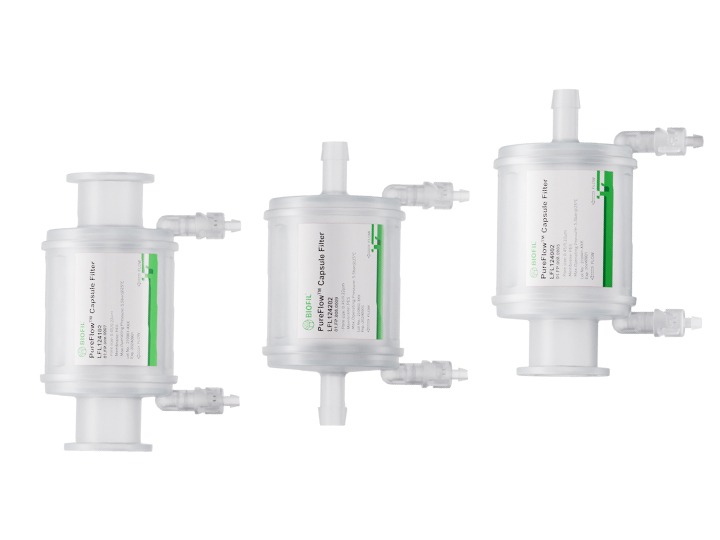
Multiple connection options available, allowing for linear scale-up from R&D to process scale
Features
Reliable bacterial and particulate retention capacity
Excellent biocompatibility and broad chemical compatibility (pH 1-14)
Ultra-low extractable levels and without fiber shedding, avoiding contamination of fluids
Undergone 100% filter integrity assessment

Material

Filter Membrane

Polyethersulfone (PES)

Filter Membrane

Protective Layer: Polypropylene (PP)

Capsule Housing

Polypropylene (PP)

Filter Membrane Protective Layer

Polypropylene (PP)

O-ring

Silicone

Conforming to USP Class VI standards

Order Information

PureFlow™ Capsule Sterilizing Filters

Cat. No. Size Effective Filtration Area (m²) Membrane
Material
Membrane
Pore Size
Connection
(Inlet / Outlet)
Sterile Qty. Per Box Qty. Per Case
LFD124303 D Series 0.03 PES 0.2μm + 0.45μm 1/4" Multi Stepped Hose Barb
1/4" Multi Stepped Hose Barb
Y 5 20
LFL124002 2'' 0.1 PES 0.2μm + 0.45μm 1" Sanitary Flange
3/8" Single Stepped Hose Barb
Y 1 4
LFL124102 2'' 0.1 PES 0.2μm + 0.45μm 1" Sanitary Flange
1" Sanitary Flange
Y 1 4
LFL124202 2'' 0.1 PES 0.2μm + 0.45μm 3/8" Single Stepped Hose Barb
3/8" Single Stepped Hose Barb
Y 1 4
LFL124005 5'' 0.2 PES 0.2μm + 0.45μm 1" Sanitary Flange
3/8" Single Stepped Hose Barb
Y 1 4
LFL124105 5'' 0.2 PES 0.2μm + 0.45μm 1" Sanitary Flange
1" Sanitary Flange
Y 1 4
LFL124205 5'' 0.2 PES 0.2μm + 0.45μm 3/8" Single Stepped Hose Barb
3/8" Single Stepped Hose Barb
Y 1 4
LFL124010 10" 0.4 PES 0.2μm + 0.45μm 1" Sanitary Flange
3/8" Single Stepped Hose Barb
Y 1 4
LFL124110 10" 0.4 PES 0.2μm + 0.45μm 1" Sanitary Flange
1" Sanitary Flange
Y 1 4
LFL124210 10" 0.4 PES 0.2μm + 0.45μm 3/8" Single Stepped Hose Barb
3/8" Single Stepped Hose Barb
Y 1 4

Frequently Asked Questions

Size information of commonly used microwell plates?
The well plate size of this series conforms to ANSI/SBS well plate size standard, American National Standards Institute (ANSI ) and Society for Biomolecular Sciences (SBS, now affiliated to the Society for Laboratory Automation and Screening ( SLAS))
What is the chemical resistance of microwell plate?
In general, well plates are used for solution and cell culture. If organic solvents are involved, please confirm and verify the well plates according to the specific material of its before use.
What is the range of centrifugal force that the microwell plate can withstand?
We recommend that the centrifugal force not exceed 1,300 g. If there are other treatments affecting the mechanical strength of the well plate before centrifugation, the above suggestions may not be applicable. Please test and verify before use.
Does the deep well plate can be applied to cell culture?
It’s mainly used for sample treatment and preservation. The surface made of polypropylene has not been treated, and we have not tested it for cell culture. So it is recommended that you pre-test for specific applications and conditions before conducting relevant experiments.
Call Now Button